
Why Is Your Crank Spindle Chewing Up the Bottom Bracket Dust Cover?

You may encounter the crank spindle wearing into the bottom bracket dust cover.
This can create movement and accelerate wear. So, what causes it, and can a different dust-cover material solve the problem?
The short answer is: the material matters, but finding the source of the movement is even more important.
What Causes a Crank Spindle to Chew Into a Dust Cover?
A correctly installed bottom bracket should not have any play between the frame, bottom bracket, bearings and crank spindle.
Check the bottom bracket fit in the frame
One simple check is to see how easily the bottom bracket can be pressed into and removed from the frame shell.
If the bottom bracket goes in and out unusually easily, there may be wear on the frame shell already, or the frame’s tolerance may not be within specification.
Check the crank spindle fit
You can also check how easily the crank spindle passes through the bottom bracket.
If the spindle feels excessively loose or there is noticeable movement once installed, this may be where the unwanted play is coming from.
The fundamental goal is to identify where the play is coming from.
Does Dust-Cover Material Make a Difference?
Yes. The material can make a significant difference to what happens if there is contact between the spindle and dust cover.
Common dust-cover designs and materials include:
Delrin
Aluminium/alloy
Chrome steel (Mounted directly on the bearing)
When a play exists, the spindle continuously rubs against the dust cover; one of the two components will eventually wear. Which component wears first depends largely on which material is softer.

Delrin dust covers
Delrin is a strong engineering plastic with some flexibility. This allows it to accommodate a small amount of movement.
The Delrin dust cover can wear over time without necessarily causing damage to the crank spindle.

Aluminium sleeves
An aluminium sleeve provides a different approach.
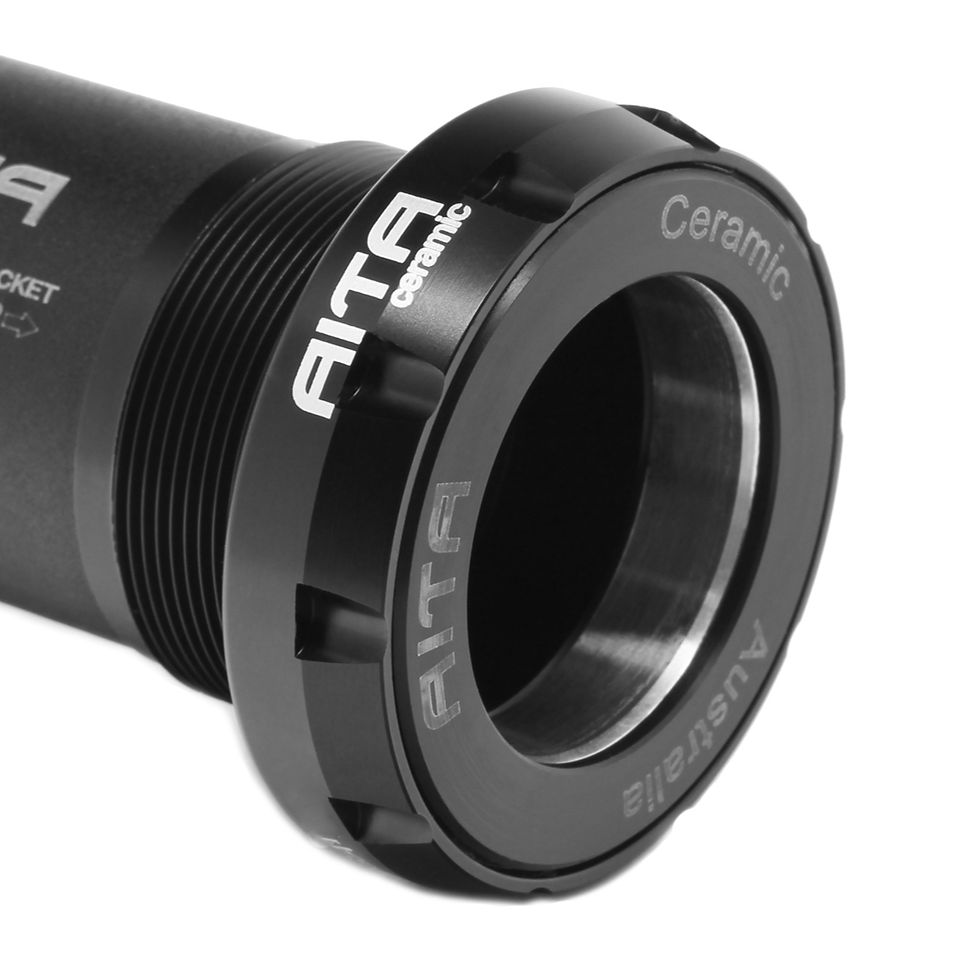
For example, AITA ceramic bottom brackets use an aluminium sleeve at the point where it contacts the crank spindle.
If the spindle rubs against the sleeve, the aluminium sleeve should wear before the crank spindle, helping protect the more expensive component.
Mounted directly on the bearing
Some designs mount the spindle directly on the bearing.
If the spindle is chewing into a metal component and the spindle itself becomes the softer or more vulnerable component, you could end up damaging the crank spindle — which can be considerably more expensive to replace than a dust cover.
What About Bottom Bracket Creaking?
Play and creaking can sometimes be related to the fit between the frame and bottom bracket.
For this reason, we recommend using a suitable HSC anti-creaking grease during installation, particularly where frame-to-bottom-bracket contact is involved.
Our HSC bottom brackets are designed to fit tightly in the frame, while our anti-creaking grease helps address minor movement and contact between mating surfaces.
A Practical Approach to a Chewed Dust Cover
If you have discovered that your crank spindle is chewing into the dust cover, we recommend checking the system in this order:

1. Check the bottom bracket-to-frame fit: Is the bottom bracket fitting tightly into the frame shell?
2. Check the spindle-to-BB fit: Does the crank spindle pass through the BB bearing smoothly without excessive movement?
3. Check for crank or bottom-bracket movement: Once installed, is there noticeable lateral movement?
4. Inspect the dust cover: Look for grooves, wear marks or deformation caused by the spindle.
5. Identify the material: Determine whether the dust cover is Delrin, aluminium/alloy or metal.
6. Address the source of the play. Replacing the dust cover without addressing excessive movement may only provide a temporary solution.
Can a More Durable Dust Cover Help?
Absolutely — but durability should not be judged only by how hard the material is.
If a dust cover is being damaged because of excessive movement, a harder material may simply transfer the wear somewhere else. In the worst case, the crank spindle could become the component that wears.
A replaceable Delrin dust cover can be advantageous because it is relatively inexpensive and replaceable, while helping protect the crank spindle and bearing assembly.
For riders who are experiencing recurring dust-cover wear, we therefore recommend looking at the complete bottom-bracket system, rather than simply looking for the hardest possible dust cover.
Useful link:
Bottom Brackets: https://www.bikebearingstore.com.au/bottom-brackets Anti-Creaking Grease https://www.bikebearingstore.com.au/product-page/hsc-bottom-bracket-anti-creaking-grease-5ml HSC Ceramic Bottom Bracket Dust Cover Replacement https://store.hscceramics.com.au/product/ceramic-bottom-bracket-dustcaps AITA Ceramic Bottom Bracket Sleeve https://aitaceramic.com/spare-parts/


